
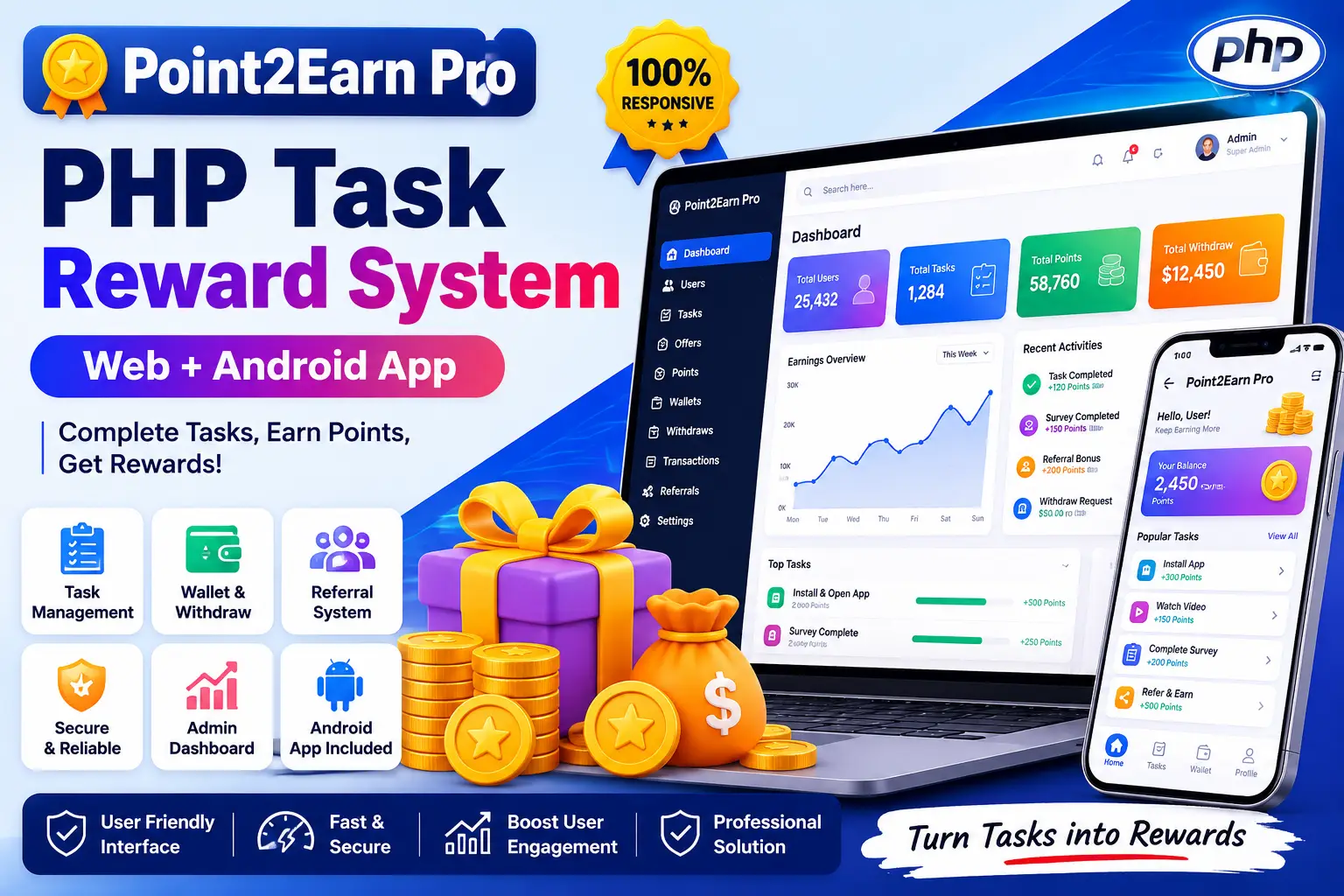
Point2Earn Pro: Task Reward System (Web + Android App)
Launching a task-based rewards website usually requires more than a simple landing page. A practical platform needs user accounts, task management, points, referrals, wallet activity, withdrawals, administration tools, and a mobile-friendly experience. Building all of those components from scratch can take considerable development time.
Point2Earn Pro: Task Reward System (Web + Android App) is a PHP-based reward platform designed for entrepreneurs, developers, agencies, and online businesses that want to launch their own task and rewards website with Android app support. According to the product documentation, the platform combines a task engine, dynamic points conversion, user wallets, transaction management, referrals, Google login integration, and an Android Studio-ready mobile application source.
The main appeal is not simply that it is a PHP script. The bigger advantage is that it brings several pieces of a reward ecosystem into one project, giving the site owner a starting point for building a branded task-based platform instead of developing every system independently.
This guide explains what Point2Earn Pro does, how its architecture and features can fit into a reward business model, what the administrator should configure, what users can experience, what to consider before launch, and which security and operational practices matter for a platform that handles accounts, points, and withdrawals.
What Is Point2Earn Pro?
Point2Earn Pro is a PHP task reward platform intended to help you launch your own digital reward website. The product listing describes it as a platform where users can complete activities such as surveys, app installations, referrals, KYC-related tasks, and other digital activities to receive points.
It is positioned as a combined web application plus Android app source package. The listed files include PHP, HTML, CSS, JavaScript, SQL, APK, and Java components, while the Android portion is described as Android Studio-ready source code.
That combination makes the script interesting for several use cases:
- Task and reward websites
- Points-based user engagement platforms
- Micro-task portals
- Referral-driven reward communities
- Digital campaign and incentive platforms
- Businesses that want a web and mobile reward experience
It is important to understand what this means from a business perspective. A script can provide the software infrastructure, but it does not automatically create profitable tasks, advertisers, users, or guaranteed income. Your results will depend on how the platform is configured, where tasks come from, how rewards are funded, how fraud is controlled, and how effectively the service is marketed.
Why Choose a PHP Task Reward System?
PHP remains a common technology for websites that require database-driven functionality, authentication, dashboards, forms, administration systems, and transaction workflows. A task-reward platform needs many of these components.
With a PHP-based system, the website can handle server-side operations such as user authentication, task records, point balances, withdrawal requests, transaction histories, and administrative controls. The browser or mobile client can communicate with the server while the backend remains responsible for business logic and persistent data.
For businesses that already use PHP hosting, this can be a practical starting point. The Point2Earn Pro documentation lists shared hosting and PHP 8.2 or the latest version as requirements. Before deployment, however, it is sensible to confirm your hosting environment against the current PHP support lifecycle and the script's own compatibility requirements.
PHP publishes an official supported-version lifecycle, with releases moving from active support to security-only support and eventually end of life. Maintaining a currently supported PHP branch is an important part of long-term website security and maintenance. Check the official PHP supported versions page before choosing a production environment.
Core Features of Point2Earn Pro
1. Powerful Task Management Engine
The task engine is one of the most important parts of a reward platform. Point2Earn Pro is documented as supporting digital task creation and management, including task types such as app downloads, KYC-related activities, and surveys.
For an administrator, task management is the foundation of the platform. A typical workflow can include creating a task, defining its requirements, assigning a point value, publishing it, monitoring completions, and reviewing the resulting user activity.
A well-organized task system should make it possible to answer basic operational questions quickly:
- What tasks are currently available?
- How many users have started a task?
- How many completions have been recorded?
- How many points have been issued?
- Which tasks are generating the most activity?
- Which tasks require manual review?
The exact workflows available to you will depend on the implementation and configuration of the script, so it is worth testing each administrator function before taking the platform live.
2. Dynamic Points Conversion
A reward site needs a clear relationship between actions and points. Point2Earn Pro includes a dynamic points conversion system, giving the administrator a mechanism for defining how task activity relates to the platform's internal point economy.
This is important because points are not just decorative numbers. They form the accounting layer between user activity and rewards. If the conversion model is unclear, users can become confused about the actual value of their balance.
A simple example might look like this:
| Activity | Example Points | Purpose |
|---|---|---|
| Complete a short survey | 100 points | Reward user participation |
| Install and complete an app task | 500 points | Reward a higher-value action |
| Complete a referral condition | 250 points | Encourage user acquisition |
| Verified special task | 1,000 points | Reward a premium campaign |
These values are only examples, not claims about the product's default reward amounts. Your own point economy should be designed around task costs, revenue, fraud risk, withdrawal obligations, and the value delivered by each action.
3. Wallet and Withdrawal Management
Once users earn points, the platform needs a way to display balances and handle withdrawal-related activity. Point2Earn Pro lists wallet and withdrawals together with transaction management as part of its secure user system.
A wallet interface can make the user journey easier to understand by showing the current balance, available rewards, and transaction history in one place. It also gives administrators an area to review requests and maintain a consistent accounting trail.
This area deserves special attention during testing. Any system that represents monetary value or redeemable points should be checked carefully for duplicate credits, incorrect deductions, race conditions, invalid requests, and unauthorized balance changes.
4. Referral Functionality
Referral systems can help a reward platform grow by encouraging existing users to invite new participants. Point2Earn Pro documentation lists referral functionality among the included features.
A sensible referral program should be easy to understand. The site owner should clearly explain when a referral qualifies, what action triggers a bonus, whether there is a minimum activity threshold, and what happens if a referral account is later determined to be fraudulent.
Referral programs also require abuse prevention. Rewarding every registration without meaningful validation can attract fake accounts, duplicate signups, bots, or self-referrals. A good referral policy should therefore be combined with account verification, rate limits, monitoring, and clear terms.
5. Google Login Integration
Point2Earn Pro lists Google login integration as part of its authentication-related features. Social sign-in can reduce friction during registration because users do not necessarily need to create a separate password for the platform.
Authentication is a critical security area. OWASP recommends treating authentication, session management, and credential handling as core parts of application security rather than as secondary features. Review the OWASP Authentication Cheat Sheet when configuring or extending your platform.
Web + Android App: Why the Combination Matters
One of the strongest selling points of Point2Earn Pro is the combination of a website and an Android application source.
The product documentation states that the package includes an Android Studio-ready source, an app-style interface, bottom navigation, and smart app/web UI switching. This means the project is intended to support a mobile experience rather than leaving the mobile side as an afterthought.
For users, a mobile app can make task discovery and repeat engagement more convenient. For an administrator, it creates an opportunity to maintain a single reward ecosystem that can be accessed from multiple devices.
The Android package should still be treated as a real software project that requires testing. Before publishing an app, review permissions, API communication, authentication, storage, error handling, and third-party dependencies. Android Developers recommends minimizing unnecessary permissions, protecting sensitive data, using secure communication, and following appropriate authentication and integrity practices.
Read Android's official privacy and security guidance for a useful checklist when preparing the mobile component.
Modern UI and Responsive Design
Point2Earn Pro is described as using a Tailwind CSS-based interface with a Glassmorphism-inspired visual design, animations, gradients, dark mode, and responsive layouts.
Visual styling matters, but usability matters more. A reward platform has several screens that users may visit repeatedly: task lists, task details, wallet pages, referral areas, profile settings, and withdrawal forms.
A good interface should make those workflows obvious.
- Users should immediately understand their current point balance.
- Available tasks should be clearly separated from completed or unavailable tasks.
- Reward values should be easy to identify.
- Withdrawal instructions should be visible before a request is submitted.
- Error messages should explain what went wrong and what the user can do next.
- Mobile controls should remain easy to use on smaller screens.
Design trends can make the interface look modern, but clarity should always come first.
How Point2Earn Pro Can Work as a Business Platform
The most useful way to think about Point2Earn Pro is as the foundation for a reward business rather than a finished business model by itself.
A simplified ecosystem might work like this:
- You launch the PHP website on your own domain and hosting.
- You configure the task and reward rules.
- You add legitimate campaigns or activities for users to complete.
- Users register through the website or Android application.
- Users complete eligible tasks.
- The system records completion and awards points according to your rules.
- Users accumulate eligible points in their wallet.
- Users submit withdrawal or redemption requests according to your policy.
- The administrator reviews activity, manages transactions, and monitors the platform.
This model gives the site owner control over branding, task structure, rewards, user experience, and administrative workflows.
Step-by-Step Guide to Launching Point2Earn Pro
Step 1: Choose the Domain and Hosting
Start with a domain that matches your brand and a hosting environment that meets the script requirements. The product listing specifies shared hosting and PHP 8.2 or the latest version. Because hosting providers vary in PHP configuration, memory limits, database versions, SSL configuration, and file permissions, review the environment before uploading the script.
For a public rewards platform, HTTPS should be treated as essential. Users may sign in, submit forms, and interact with account-related data, so secure transport is necessary.
Step 2: Prepare the Database
The published installation instructions describe creating a database and importing the supplied SQL file. Your hosting control panel may provide tools such as phpMyAdmin for this step.
Before importing a database backup or SQL package, confirm the database credentials and character set settings. Keep separate production and development databases where practical.
Step 3: Upload the PHP Files
Upload the application files to the correct directory on the server and review the configuration files. Update database credentials, site URL settings, and any environment-specific configuration required by the script.
Do not copy development credentials into production. Remove test accounts and replace any sample secrets or credentials included solely for demonstration.
Step 4: Configure the Administrator Area
The administrator area should be the control center for your reward business. Configure site branding, task categories, points logic, referral settings, wallet rules, user-management settings, and any available security controls.
Spend time learning the workflow before inviting real users. It is much easier to identify configuration mistakes when you are the only test account using the site.
Step 5: Create and Test Tasks
Add a small number of controlled test tasks. Verify the complete sequence from task availability through completion and point crediting.
Test both successful and unsuccessful cases. For example, what happens if a user refreshes the completion page twice? What happens if the user cancels halfway through? What happens if an external task provider reports an error?
These edge cases are often more important than the initial happy-path demonstration.
Step 6: Test the Wallet and Withdrawals
Use test accounts to confirm that points are added correctly, balances remain consistent, and transaction records match wallet changes.
Do not switch immediately to real payout operations. First verify the rules for minimum withdrawal amounts, duplicate requests, pending statuses, rejected requests, and completed requests.
Step 7: Prepare the Android App
The listed package includes Android-related source files and an Android Studio-ready project. Open the source in the appropriate development environment, configure the package details, point the application toward your production backend, and test authentication and task flows.
Before publication, review the current Google Play requirements, privacy disclosures, data collection practices, app permissions, and third-party SDKs.
Step 8: Perform Security and Performance Checks
Use HTTPS, strong administrator credentials, regular backups, current dependencies, sensible permissions, and server monitoring. Test the application under realistic traffic conditions, especially if you expect a large number of simultaneous task requests.
Android's official security guidance recommends minimizing sensitive data collection, securing network communication, protecting stored data, and keeping dependencies up to date. See Android's security checklist for additional implementation guidance.
Who Can Benefit From Point2Earn Pro?
Point2Earn Pro can be useful for several types of buyers.
Developers
Developers can use a ready-made project as a starting point instead of building authentication, tasks, points, wallets, referrals, and mobile UI from zero. This can be particularly useful when the goal is to customize an existing architecture.
Digital Agencies
Agencies may use a task reward system as the foundation for client projects, internal incentive platforms, or campaign-based engagement products. The ability to customize branding and workflows can make a source-code-based solution more flexible than a hosted third-party service.
Entrepreneurs
Entrepreneurs who have a clear reward business model can use the script as a software foundation while concentrating more heavily on user acquisition, partnerships, campaign sourcing, compliance, customer support, and retention.
Online Communities
Communities that want to reward participation can build structured point systems around approved activities. This might include campaigns, promotions, educational activities, or verified digital tasks.
Advantages of Point2Earn Pro
| Area | Potential Advantage |
|---|---|
| Technology | PHP-based web application with database-backed functionality |
| Task Management | Built-in task creation and management capabilities |
| Rewards | Dynamic points conversion and wallet functionality |
| User Growth | Referral functionality can support user acquisition |
| Authentication | Google login integration is listed among the features |
| Mobile | Android Studio-ready source is included |
| Design | Responsive interface with Tailwind CSS and modern visual styling |
| Administration | Central management of tasks, users, wallets, and transactions |
Important Limitations to Understand
No reward script should be treated as a magic income generator. The software can automate workflows, but the business still depends on real economics and responsible administration.
You will need to consider where task revenue comes from, how much you can afford to pay users, what happens when a task is reversed, how you identify fraudulent activity, and how withdrawals are funded.
You should also avoid marketing the platform with unrealistic income promises. A task system can provide opportunities for users, but actual earnings depend on the tasks available, eligibility, geographic availability, completion requirements, reward rates, and the rules of your particular platform.
Tips and Best Practices for Running a Reward Website
Keep the Points Economy Transparent
Publish clear information about how users earn points, how points are converted, whether points can expire, and how withdrawals work. Hidden rules create unnecessary disputes.
Build Fraud Prevention Into the Business Model
Reward systems are attractive targets for abuse because account actions can produce something with monetary value. Consider device, IP, behavioral, referral, and transaction-level monitoring where appropriate and lawful.
Protect Administrator Accounts
An administrator account may have the ability to change balances, tasks, rewards, or settings. Use strong credentials, limited access, secure sessions, and regular account reviews.
Back Up the Database
The database can contain essential business records such as users, tasks, points, wallet transactions, and settings. Maintain a tested backup and recovery process rather than assuming the hosting company alone is enough.
Keep PHP and Dependencies Current
Technology changes over time. PHP versions reach the end of their security support lifecycle, and third-party components can receive vulnerability fixes. Regular maintenance is therefore part of operating the platform, not an optional extra. Review the current PHP support lifecycle as part of your maintenance plan.
Make Support Easy to Find
Users will inevitably have questions about task qualification, missing points, withdrawals, rejected activities, and account access. Clear support documentation can reduce repetitive tickets and improve trust.
Common Mistakes to Avoid
1. Launching Without Testing Withdrawals
Task completion may appear to work while the wallet or withdrawal workflow contains errors. Always test the full financial lifecycle using controlled accounts before production launch.
2. Using Unrealistic Reward Values
If you award too many points relative to the actual value of a task, the system may become financially unsustainable. Reward economics should be calculated before publishing campaigns.
3. Ignoring Fraud
A reward system without fraud controls can quickly become expensive. Duplicate accounts, referral abuse, automated task completion, and manipulated requests should be considered during system design.
4. Treating the Demo as the Final Configuration
Demo credentials and example settings are designed for testing. Production environments should use new administrator credentials, secure configuration, real branding, and properly defined business rules.
5. Publishing an App Without Reviewing Privacy
Mobile applications may process account information, device data, authentication tokens, or other sensitive information depending on the implementation. Review what your app collects, why it collects it, and how it is stored or transmitted.
6. Overloading the Website With Ads
If you plan to monetize your content with Google AdSense, remember that publisher policies govern the pages where ads appear. Google states that publishers are responsible for ensuring their content and implementation comply with its policies, including rules against artificially inflating clicks and encouraging invalid ad interactions.
Read Google's official AdSense Program Policies before adding advertising to the platform.
Point2Earn Pro vs Building a Custom Platform From Scratch
| Factor | Point2Earn Pro | Custom Development |
|---|---|---|
| Starting Point | Existing PHP application | Built from zero or from a framework |
| Development Time | Potentially faster initial deployment | Usually requires more development work |
| Customization | Depends on source code and architecture | Full control over architecture and features |
| Mobile Support | Android source included | Requires separate mobile development |
| Maintenance | Still requires ongoing updates and security work | Fully owned development responsibility |
| Technical Control | Based on the supplied project architecture | Maximum architectural control |
The better choice depends on the project. A ready-made PHP script can be attractive when speed to prototype matters. Full custom development becomes more compelling when your business requires highly specialized workflows, integrations, compliance requirements, or a unique architecture.
How to Make Your Point2Earn Website More Trustworthy
Trust is especially important on platforms that use points, referrals, wallets, and withdrawals.
Start with clear documentation. Explain the point system, task rules, eligibility conditions, withdrawal process, account restrictions, and support channels in language that ordinary users can understand.
Then make your policies visible. A professional platform should have clear privacy information, terms of use, refund or transaction policies where applicable, and rules for fraudulent behavior.
Next, maintain an understandable transaction history. If a user's points change, the account should ideally provide enough context for the user to understand why.
Finally, avoid claims you cannot prove. Google recommends creating helpful, reliable, people-first content and emphasizes that pages should provide substantial value rather than being created primarily to manipulate search rankings. Review Google's people-first content guidance when preparing promotional and informational pages for your project.
Is Point2Earn Pro Worth Considering?
Point2Earn Pro is worth considering for buyers who want a ready-made foundation for a task-reward website and Android application rather than starting every component from scratch.
Its documented feature set covers many of the core building blocks expected in this type of project: task management, points conversion, wallets, withdrawals, transactions, referrals, Google authentication, responsive UI, and Android source code.
The biggest question is not whether the script contains useful components. The more important question is whether those components match your actual business model and whether you are prepared to maintain the platform after launch.
Before purchasing or deploying any PHP script, review the current product documentation, supported server environment, included files, licensing terms, update policy, and available support. You should also test the demo where available and confirm that the workflows you need are actually present in the current release.
For more PHP scripts, developer tools, and digital products, explore the WPCodeQuill marketplace. You can also browse the WPCodeQuill blog for tutorials, development guides, and related technology topics.
Frequently Asked Questions
What is Point2Earn Pro?
Point2Earn Pro is a PHP-based task reward platform designed to help you launch your own earning and rewards website. The documented features include tasks, points conversion, referrals, wallets, withdrawals, transactions, and user authentication.
Does Point2Earn Pro include an Android app?
Yes. The product documentation states that it includes Android Studio-ready source code with a mobile-friendly, app-style interface. The listed package also includes Android-related files such as Java source and an APK.
What types of tasks can Point2Earn Pro support?
The published feature list mentions activities including app downloads, KYC-related tasks, surveys, referrals, and other digital activities. Your exact task model will depend on how you configure the system and what legitimate campaigns or integrations you provide.
What hosting is required for Point2Earn Pro?
The current product documentation lists shared hosting and PHP 8.2 or the latest version. Hosting requirements can change as software is updated, so check the current product page before deployment and verify your server configuration.
Can I customize points and rewards?
The product FAQ states that administrators can manage tasks and configure the reward system, including points conversion, user wallets, and transactions. The amount of customization available depends on the provided code and your development skills.
Does buying the script guarantee earnings?
No. A software script provides infrastructure; it does not guarantee revenue, user growth, advertiser demand, or profitable task campaigns. The financial performance of a reward platform depends on your business model, task sourcing, reward economics, audience, marketing, fraud prevention, and operational management.
Is an Android app enough to guarantee Google Play approval?
No. Having Android source code does not automatically guarantee store approval. The app still needs to meet the current Google Play requirements, privacy expectations, technical standards, and applicable policies. Review the current requirements before publishing.
Is Point2Earn Pro suitable for beginners?
It can be a useful starting point for beginners who are comfortable with basic hosting and website administration, but running a production reward platform involves more than uploading files. Database setup, security, task configuration, fraud prevention, payouts, backups, and ongoing maintenance all require attention.
Conclusion
Point2Earn Pro: Task Reward System (Web + Android App) is designed as a practical software foundation for businesses that want to build a task-based reward platform with both web and Android experiences.
Its documented feature set includes a task management engine, dynamic points conversion, wallets and withdrawals, transaction management, referral functionality, Google login, responsive UI components, and Android Studio-ready source code. Those features can reduce the amount of groundwork required to develop a reward platform from scratch.
At the same time, successful deployment requires more than installing a PHP script. You need a sustainable reward economy, trustworthy tasks, strong security, fraud controls, reliable transaction processing, clear user policies, mobile testing, and ongoing maintenance. PHP and Android components should be kept up to date, and privacy and advertising requirements should be reviewed before production launch.
For developers, agencies, and entrepreneurs who already have a clear task-reward business concept, Point2Earn Pro can serve as a useful starting point for turning that idea into a functioning web and mobile platform. The next step is to evaluate the current product documentation carefully, test the available workflows, and adapt the system to your specific operational requirements.
For more development resources and digital products, visit the WPCodeQuill website and explore the WPCodeQuill blog for additional guides and tutorials.
Editorial note: Product features and technical details in this article are based on the current Point2Earn Pro product documentation available from WPCodeQuill at the time of writing. Pricing, included files, compatibility, licensing, and features can change between releases, so verify the current product listing before making a purchase or production deployment.






Discussion (0)
Join the Conversation
Please log in to post a comment.
Log In to Comment