
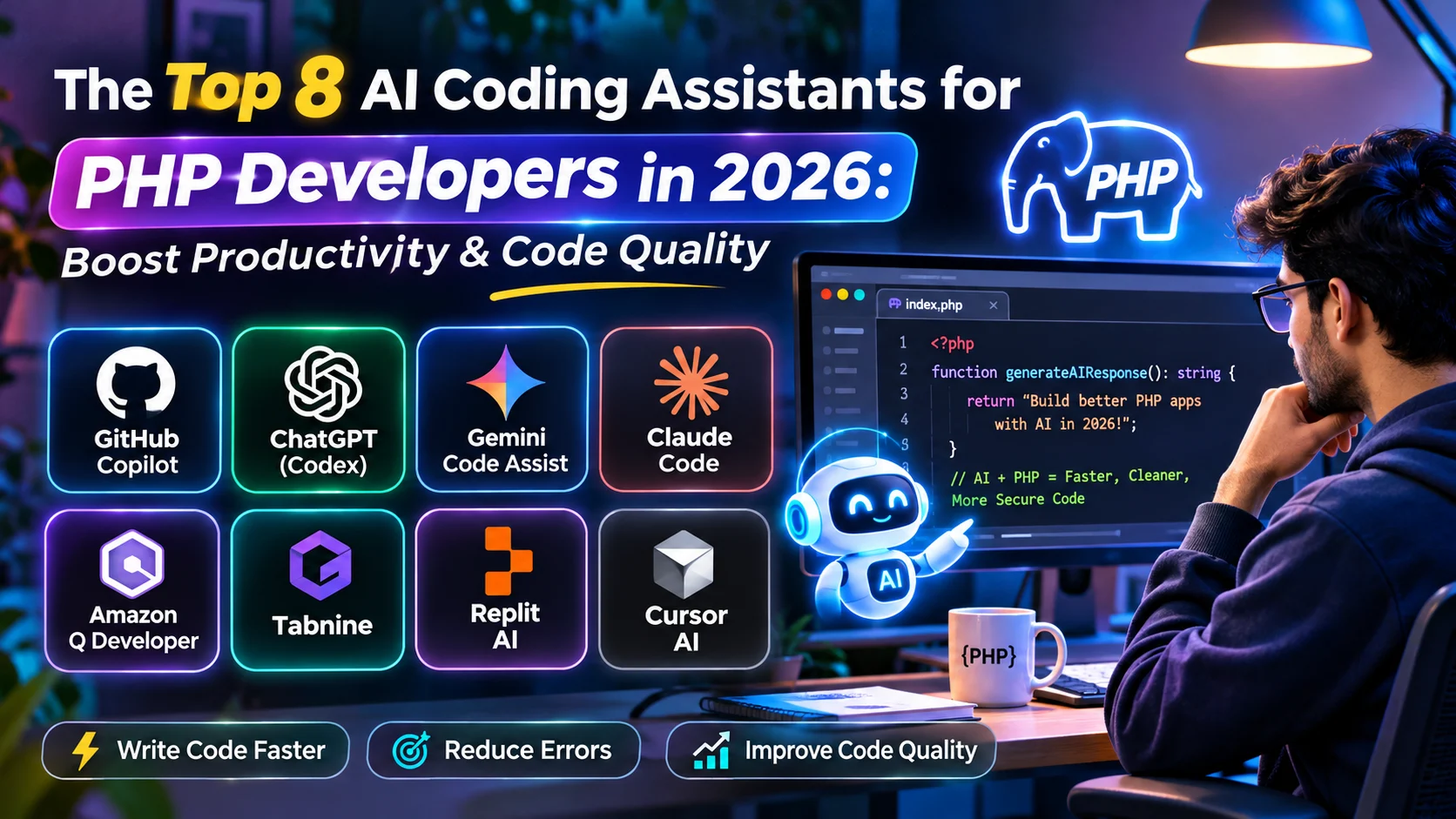
The Top 8 AI Coding Assistants for PHP Developers in 2026: Enhance Productivity & Code Quality
PHP continues to power an overwhelming majority of the dynamic web, sustaining roughly 74% of all websites globally. Yet, the demands placed on modern PHP developers have grown significantly: complex microservices, massive monolithic enterprise legacy systems, real-time reactive stacks with tools like Laravel Reverb, and intricate framework abstractions like Symfony bundles or WordPress block APIs.
In this high-velocity environment, artificial intelligence is no longer just an experimental toy for basic autocomplete. It has matured into an active pair programmer, architectural reviewer, and automated test orchestrator. However, general-purpose models often falter when faced with PHP idioms—frequently suggesting outdated procedural syntax, missing modern PHP 8.2+ type safety rules, or butchering Eloquent ORM relationships.
To help you navigate this space, we evaluate the top 8 AI coding assistants for PHP developers in 2026, examining how each handles framework conventions, multi-file codebases, IDE ergonomics, and code privacy.
Why AI Coding Assistants Matter for Modern PHP in 2026
Adopting an AI coding assistant isn't merely about typing fewer keystrokes; it addresses fundamental technical bottlenecks common in modern PHP software lifecycles:
- Modernizing Legacy Codebases: Seamlessly refactoring PHP 5.x or 7.x procedural code into strictly typed PHP 8.x architectures with enums, attributes, constructor property promotion, and readonly classes.
- Framework-Aware Scaffolding: Producing fully coherent stacks—such as a Laravel model, migration, FormRequest validation, resource controller, and Pest test file—without manual boilerplate construction.
- Automating Test Suites: Instantly generating PHPUnit or Pest unit and feature tests with mocked dependencies and factories.
- Static Analysis & Security Audits: Identifying SQL injection risks, insecure deserialization, and N+1 database queries before code ever hits a pull request.
Essential Selection Criteria for PHP Developers
Before adopting an AI coding tool, benchmark it against these language-specific metrics:
- Deep Syntax & Framework Awareness: Does the model recognize modern features like match expressions and intersection types, or does it default to deprecated patterns? Does it understand Eloquent conventions and Symfony service containers?
- Context Engine & Multi-File Reasoning: Can the AI read your Composer dependencies, custom service providers, and database schemas across multiple directories?
- IDE Integration: Does it run natively in PhpStorm, VS Code, or specialized AI-native forks without lag?
- Data Privacy and Compliance: Does the provider offer zero-data-retention (ZDR), air-gapped options, or SOC 2 Type II certifications to protect proprietary enterprise IP?
The Top 8 AI Coding Assistants for PHP Developers in 2026
1. Zencoder: All-in-One Autonomous Agent with Enterprise Security
Zencoder is an autonomous, context-driven AI software engineering agent designed for enterprise-grade repositories. What sets Zencoder apart for PHP teams is its proprietary Repo Grokking™ technology, which indexes your entire codebase to understand inter-class dependencies, service bindings, and architectural logic.
Standout Features:
- Zentester: Automatically writes, executes, and fixes comprehensive Pest and PHPUnit tests.
- Cross-Repo Context: Indexes shared Composer packages and multi-repo architectures.
- Strict Security Certifications: Built with enterprise compliance, holding SOC 2 Type II, ISO 27001, and ISO 42001 certifications with full zero-data-retention guarantees.
- IDE Reach: Deep integrations available for JetBrains (PhpStorm), VS Code, and custom CI/CD pipelines.
Verdict for PHP: If your team works on large, security-sensitive applications or multi-tenant architectures where context leakage is prohibited, Zencoder is among the most comprehensive solutions available.
2. GitHub Copilot: The Industry Standard for Inline Suggestions
GitHub Copilot remains the default tool for developers globally due to its frictionless editor integration and rapid latency. Backed by OpenAI's latest models alongside custom fine-tuning, Copilot provides fast inline completions and conversational terminal help.
Standout Features:
- Copilot Agent Mode: Can build workspace-wide edits directly within supported editors.
- GitHub PR Integration: Summarizes pull requests, explains diffs, and suggests code review changes directly within GitHub.
- CLI Assistant: Helps write complex Artisan, Composer, and Docker CLI commands.
Verdict for PHP: Excellent for general autocompletion and repetitive PHP boilerplate. However, it can occasionally output generic procedural solutions for complex Laravel or Symfony patterns unless prompted with explicit contextual rules.
3. Cursor: The Best AI-Native IDE for Full-Codebase Edits
Built as a high-performance fork of VS Code, Cursor changes how developers interact with their code by making the editor itself AI-native. Rather than confining AI to a sidebar chat, Cursor allows you to run multi-file edits, inline transformations, and natural language refactoring directly across your project tree.
Standout Features:
- Semantic Codebase Indexing: Embeds your local PHP repository so you can reference models, configs, and controllers via
@Filesor@Codebase. - Multi-File Composer Awareness: Recognizes class interfaces across vendor packages and custom namespaces.
- Project Rules via
.cursorrules: You can define custom project instructions (e.g., "Always write Pest tests, use strict types, avoid Facades") to force strict framework compliance.
Verdict for PHP: Currently the gold standard for full-project refactoring. When paired with Laravel Boost or clear project prompt rules, it delivers exceptional architectural accuracy.
4. PhpStorm AI Assistant: Native Intelligence inside JetBrains
For developers who refuse to abandon JetBrains' static analysis engine, the PhpStorm AI Assistant provides an experience integrated directly into the IDE's internal Abstract Syntax Tree (AST).
Standout Features:
- AST-Aware Context: Unlike external plugins that only see text, PhpStorm AI Assistant utilizes the IDE’s internal index of symbols, docblocks, and type hierarchies.
- Native Test Runners: Generates and executes PHPUnit/Pest tests inside your native JetBrains tool window with one click.
- Commit Message Generation: Reads staged Git diffs and outputs clean, conventional commit messages.
Verdict for PHP: The smoothest, zero-configuration setup for dedicated PhpStorm users. It respects your existing code style and formatting configurations out of the box.
5. Claude Code: Terminal-Driven Agentic Engineering
Anthropic's Claude Code brings agentic AI straight to your developer terminal. Operating via an agent loop, it can read your directories, execute Artisan commands, run PHPUnit tests, inspect stack traces, and iteratively modify files until tests pass.
Standout Features:
- Agentic Execution: Capable of diagnosing a failing test, editing the offending PHP controller, running the test suite again, and verifying the fix autonomously.
- Superior Reasoning: Leverages Anthropic's Claude 3.7 Sonnet architecture, which excels at complex architectural planning and nuanced logic puzzles.
- Zero UI Overhead: Runs entirely in your shell or terminal tab, making it ideal for headless servers or terminal-first workflows.
Verdict for PHP: Exceptionally capable for refactoring legacy logic, resolving failing CI/CD builds, and debugging intricate, deeply nested bugs.
6. Tabnine: The Gold Standard for Code Privacy and Air-Gapped Environments
For enterprise financial platforms, medical software, or government contracts running PHP, sending code to third-party public clouds is often out of the question. Tabnine focuses heavily on data sovereignity, offering private cloud, on-premises, and completely air-gapped deployments.
Standout Features:
- Strict Zero Data Retention: Does not train on customer code and strictly avoids training on non-permissive open-source licenses.
- On-Premises Deployment: Can run locally on self-hosted GPU infrastructure behind enterprise firewalls.
- IDE Neutral: Runs smoothly across PhpStorm, VS Code, and Eclipse.
Verdict for PHP: While its deep scaffolding capabilities may not match Cursor or Claude, Tabnine is the premier option for organizations with uncompromising compliance and IP security mandates.
7. Greptile: AI-Powered Code Reviews for PHP Pull Requests
Unlike standard coding copilots that assist you as you type, Greptile operates as an automated reviewer on your team's pull requests across GitHub and GitLab. It creates a complete semantic graph of your PHP project to spot subtle structural regressions.
Standout Features:
- Contextual PR Feedback: Spots breaking changes in downstream callers when an interface or method signature is modified.
- Framework Anti-Pattern Detection: Identifies unindexed database queries, accidental N+1 issues in API resources, and insecure authorization policies.
- Team Style Enforcement: Learns your team's specific architectural preferences over time.
Verdict for PHP: An invaluable addition to engineering teams looking to relieve senior developers of manual code review burdens and catch logic regressions before deployment.
8. Windsurf: Flow-Focused Context Engine
Developed by Codeium, Windsurf is an AI-powered editor designed around maintaining developer flow. Using its "Cascade" architecture, it combines real-time autocomplete with multi-step collaborative agent capabilities.
Standout Features:
- Cascade System: Blends chat, file editing, and terminal commands in a unified, non-intrusive stream.
- Fast Autocomplete: Minimal latency on inline suggestions across large PHP source trees.
- Cost-Effective Pricing: Delivers competitive feature parity with other commercial AI editors at lower entry price points.
Verdict for PHP: An outstanding daily-driver IDE for developers who want agentic features without the friction or resource consumption of heavy extension stacks.
Specialist vs. Generalist: The Laravel Developer's Conundrum
A common hurdle for PHP developers—especially those in the Laravel ecosystem—is the gap between generic PHP output and idiomatic framework code. Generalist models often generate syntactically valid code that ignores framework-specific strengths, such as:
- Writing manual SQL or verbose Query Builder syntax instead of expressive Eloquent scopes and relationships.
- Failing to utilize Form Request classes for validation, placing dirty input logic directly inside controllers.
- Overlooking modern features like Livewire 3 forms, Filament v3 schemas, or Laravel Actions.
How to Bridge the Gap:
You don't necessarily have to abandon generalist tools like Cursor or GitHub Copilot for niche tools. Instead, empower them with explicit runtime context. Tools like Laravel Boost (the official Model Context Protocol / MCP server for Laravel) allow AI assistants to query your routes, models, migrations, and database schema in real time. Combine this with a well-maintained .cursorrules file in your repository root, and generalist agents will consistently produce clean, framework-accurate code.
Best Practices for Deploying AI in Your PHP Workflow
To extract the highest ROI from these assistants without compromising code integrity, integrate these strategies into your daily routine:
- Treat Output as a Junior PR: Never blindly commit AI-generated code. Always validate business logic, boundary conditions, and security implications.
- Enforce Automated Quality Gates: Run static analysis tools like PHPStan (level 8 or 9) or Psalm alongside PHP CS Fixer immediately after AI generations to eliminate subtle typing or formatting discrepancies.
- Layer Specialized Tools: Use an in-editor agent like Cursor or PhpStorm AI for day-to-day writing, Claude Code for complex multi-step terminal debugging, and Greptile to audit pull requests.
- Ensure Reliable Deployment Infrastructure: As your team's velocity accelerates and you deploy features faster, make sure your production environments can keep up. Deploying to reliable, optimized PHP hosting infrastructure ensures your optimized code runs with peak performance, high memory limits, and minimal latency.
Frequently Asked Questions
Q: Will AI coding assistants replace professional PHP developers?
No. AI coding tools automate mechanical, repetitive tasks such as boilerplate generation, regex parsing, and basic test writing. They lack high-level architectural foresight, customer empathy, and the domain-specific business understanding required to architect scalable, secure enterprise platforms. Developers who master AI will simply deliver higher-quality software faster than those who do not.
Q: Which AI tool is best for legacy PHP refactoring?
Cursor and Claude Code stand out for legacy migrations. Their large context windows allow them to ingest extensive legacy classes, identify deprecated functions, and refactor procedural code into modern PHP 8.x typed architecture while generating parity tests to prevent regressions.
Q: Can these tools run on private, proprietary codebases safely?
Yes, provided you choose an assistant with enterprise compliance. Zencoder offers SOC 2 Type II, ISO 27001, and zero-retention guarantees, while Tabnine provides fully on-premises or air-gapped instances that ensure no proprietary code ever leaves your internal network.
Q: How do I stop AI tools from suggesting outdated PHP syntax?
Use project configuration files like .cursorrules or custom system instructions. Explicitly instruct the model: "Target PHP 8.3+. Always use strict typing (declare(strict_types=1)), constructor property promotion, match statements, and typed class constants. Avoid deprecated functions.


Discussion (0)
Join the Conversation
Please log in to post a comment.
Log In to Comment